

👋 Hi, I’m Mike. This is the companion newsletter for my podcast (Spotify, Apple, YouTube).
The biggest challenge in entrepreneurship 🏔️ is that founders of startups with no customers need a way to know if they’re about to “make something people want”. This motto from Y Combinator is a goal not a strategy. The question remains: How can founders know if their startup idea is something people want? More founders struggle with this challenge than any other and they often waste a year before recognizing that the startup was not making something people want.
Many founders try to overcome this challenge by mimicking the most successful entrepreneurs, which fails. The best entrepreneurs have an innate sense for a good startup idea, but they don’t know how it works. For instance, Paul Graham says that he has an internal compass for good startup ideas but he can’t explain it.
Measurement is the key to a meaningful solution
For the rest of us, instinct isn’t enough. Founders who use a gut-feel approach usually waste a year or more before realizing that their startup is not something people want. This painful outcome has happened to me repeatedly which is why I’m laser focused on solving the biggest challenge in entrepreneurship. I believe that measurement is the key to a meaningful solution. Specifically, I’ve created Nascent as a strategy for founders to quantify the price that their first customers might be willing to pay. This adds up to an ERNY™ value, the Estimated Revenue Next Year for a startup with no customers. In other words, Nascent replaces intuition with a metric in dollars ($) for how much people want what the startup is about to make. I want to tell you a bit about me so that you’ll have reason to trust Nascent.
Why am I the right guy to solve this challenge? Three reasons:
1. Measurement systems. I worked for years creating measurement systems for consumer products that had never been measured before. Specifically, I worked as a regulator at the US Department of Energy and Natural Resources Canada, creating energy efficiency standards and test procedures for power supplies, televisions and Christmas lights. My experience quantifying these products translates directly into my ability to measure startups with no customers.
2. Crossing borders. I’m drawn to the boundaries of things and combining seemingly different concepts. Conventional entrepreneurship strategies have not solved this challenge so we need to cross borders and bring in new ideas. This is why Nascent’s quantification frameworks include concepts from oil prospecting, nursing and behavioral economics.
3. Table stakes. I have decades of experience with the two pillars of Nascent: entrepreneurship and education. I’ve been a teacher my whole life — from a teaching assistant in college to mentoring 100 founders through the Haas School of Business at UC Berkeley. My superpower is explaining things and I’ve focused specifically on startups with no customers.
The spark for Nascent
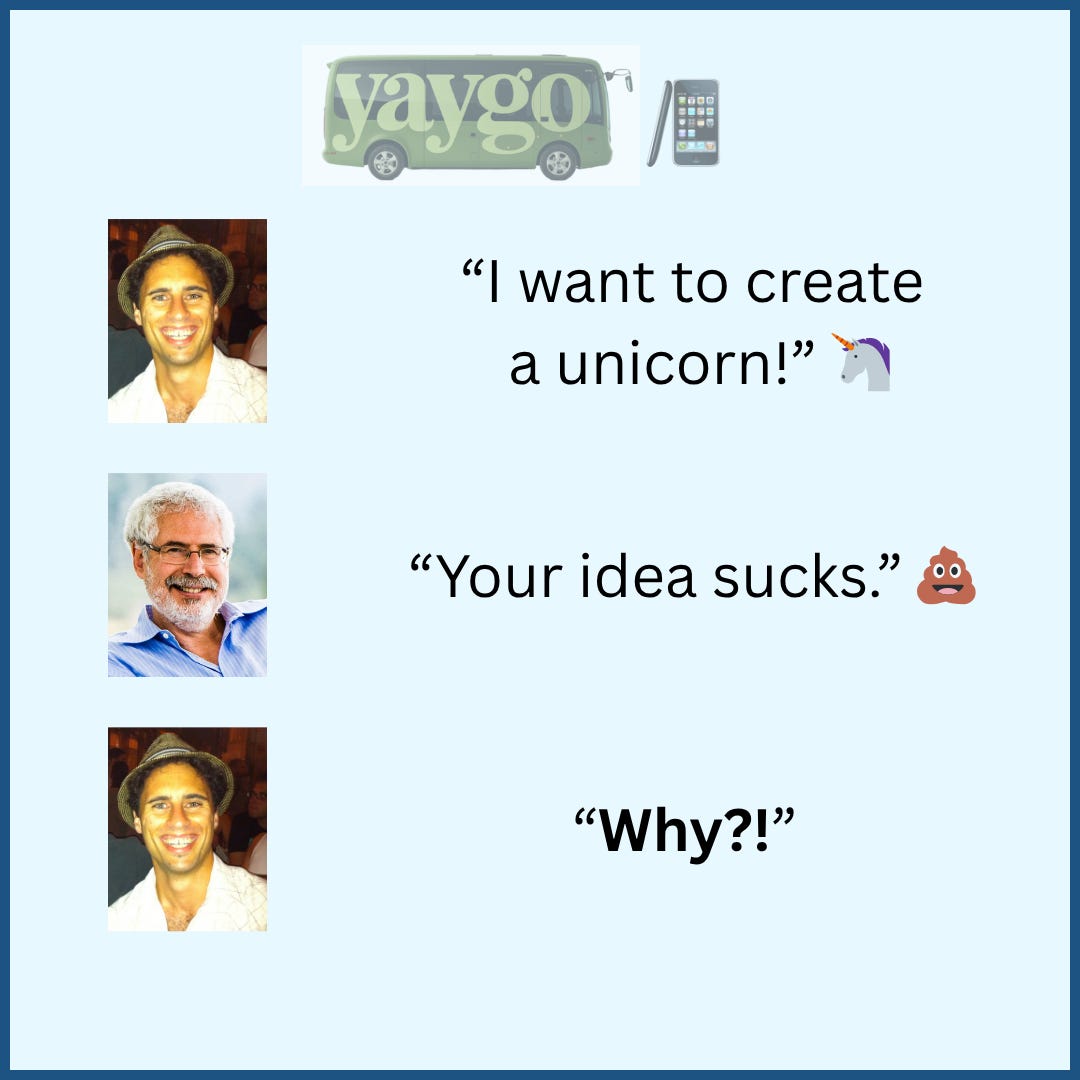
When I did my MBA at Berkeley, the best class I took was Lean Launchpad with Steve Blank and Jerry Engel where I worked on my startup, Yaygo. The professors said that my idea for Yaygo sucked, but couldn’t explain why. They were correct, but I ignored them and wasted years because I couldn’t understand their reasoning. In the class, my team and I did everything right -- we ran 100 discovery interviews and iterated a business model canvas. But I never had a robust way to analyze the data, to see why my idea sucked, to know whether Yaygo was something people wanted.
Nascent is the strategy that I wish that I would have had. Quantifying those interviews in dollars would have immediately clarified why Yaygo wasn’t worth building. I wouldn’t have needed 100 interviews and I wouldn’t have wasted years.
Now I’m trying to share Nascent with founders. To begin using Nascent, here’s your first step: record a conversation with one person who might benefit from your startup. That’s it. In Nascent strategy only recordings count -- no memory, no notes. Let me know what you record at Podcast@NascentIdea.com.
If you’re a founder of a funded startup that’s pivoting, intuition isn’t enough to decide which new idea to pursue. Let’s get on a call and talk about how to kill bad ideas fast so that you can protect your remaining runway.
As of 2026, I’m publishing Nascent methodology, a few ideas at a time, in regular podcast episodes. This is the companion newsletter that summarizes the podcast. For a deeper dive, check out the podcast on Spotify / Apple Podcasts / YouTube.