

👋 Hi, I’m Mike. This is the companion newsletter for my podcast (Spotify, Apple, YouTube).
A subscriber asked: Isn’t searching for People in Pain just marketing? Nope.
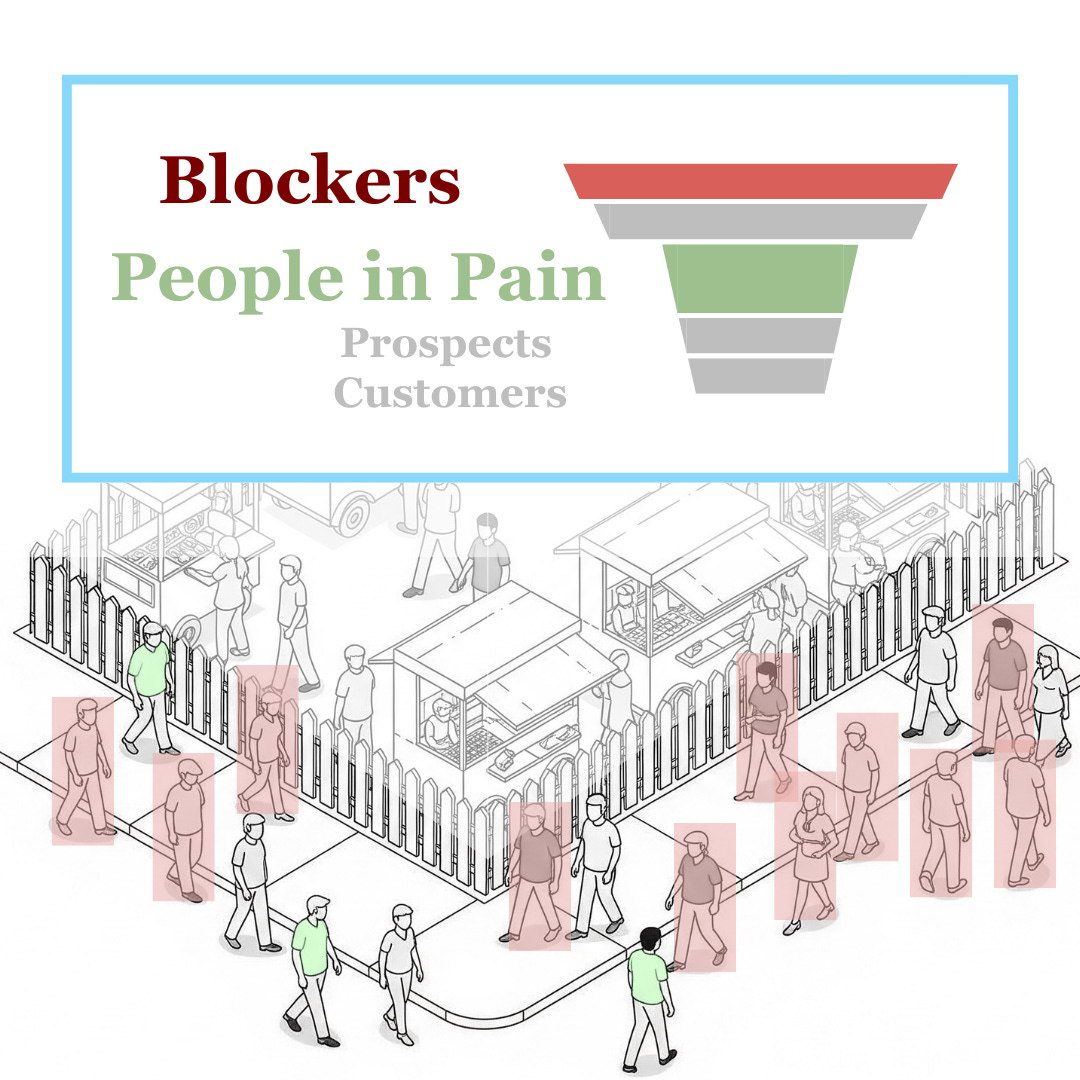
In Episode 022, I said that the only thing that matters for founders of startups with no customers is to search for invisible People in Pain™, which I illustrated using the People-to-Prospect Funnel™. Then I walked through an example applying this to a food-cart pod where the prospects and customers are visible. Meanwhile outside the pod, the people walking by are mostly blockers (people who won’t become customers) as well as rare, special People in Pain -- they’re hungry but don’t realize the food carts want to serve them.
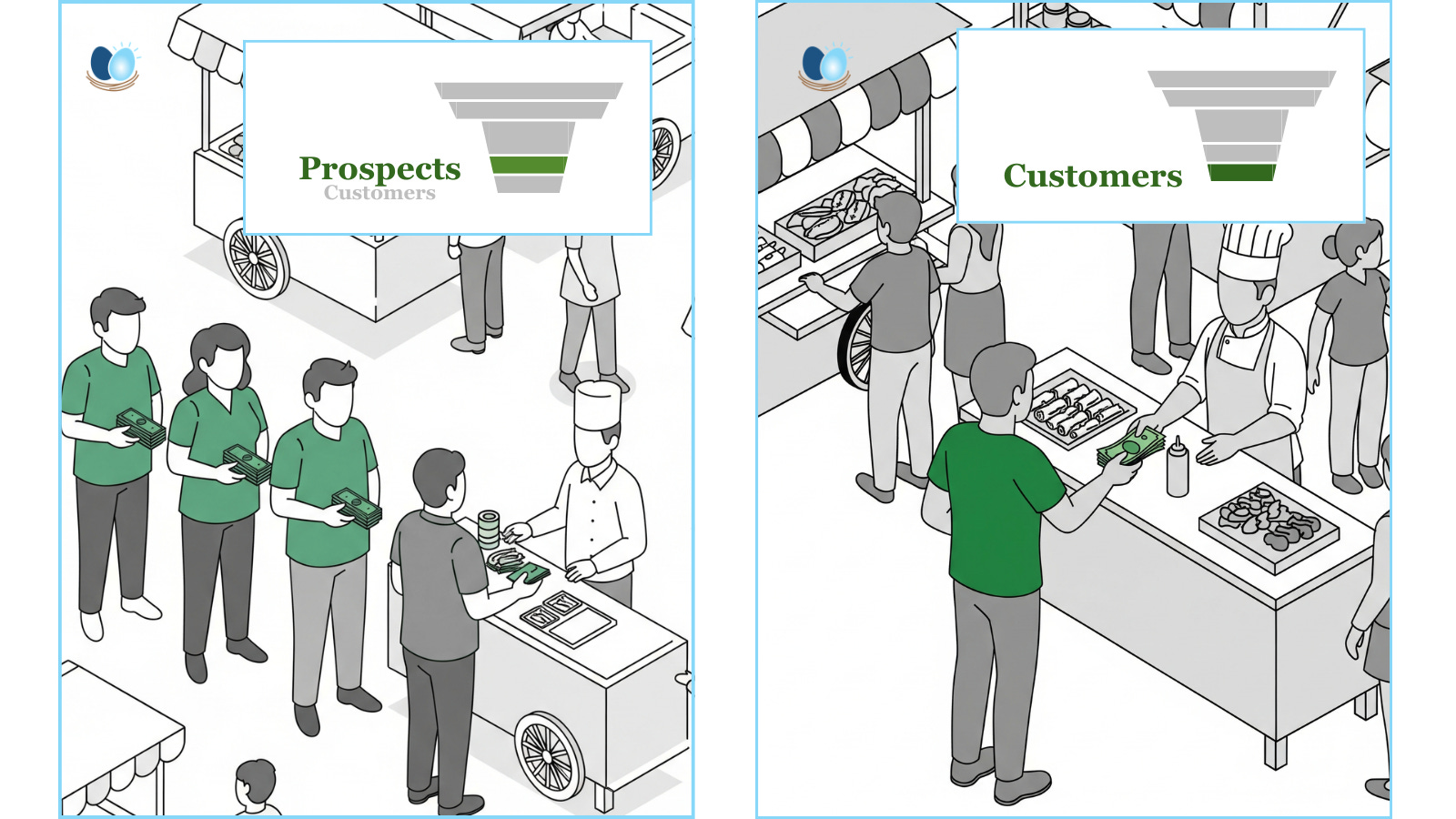
This framework in Episode 022 prompted a comment on YouTube:
the people outside the fence are possible customers. Prospects. You can put a sign that says come get some hot dogs. Isn’t that called marketing? Therefore, Finding those people in pain is marketing .
Nope. Marketing is a project to deploy existing knowledge. Searching for People in Pain is a project to decide whether to try to get that knowledge in the first place. This seemingly simple question is about a conventional hot-dog stand business where all the components are visible. The distinction is even more important for a customer-breakthrough tech startup where all the components are invisible.
To see the difference, imagine a data disaster where a marketer wakes up one day with no customer data. All of their databases were somehow wiped out but at least the business itself is still running. So the marketer can get more customer data, turn the data into knowledge and use that to make marketing decisions. As a benchmark, advertisements typically have a 1% conversion rate and cost about $10 for 1,000 ad impressions. In other words, even when a marketer has knowledge about their target audience, 99% of their advertisements are just spam wasted on blockers in an effort to send a message to the few, special People in Pain.
Now, think about the founder of a startup with no customers. Every day is a data disaster for founders. Every morning begins with a full cup of coffee and an empty database. Even worse, there’s no clear starting point because there are no customers to learn from. There is no knowledge to create a targeted marketing campaign. Today, most founders tackle this challenge by using assumptions, not knowledge. Then, after a year, the founders recognize that the startup will never get customers and that they have nothing to show for all their effort. This sucks.
To respond to the question directly: Yes, any hot-dog stand owner can just put up a sign and, yes, that could be called marketing. However, the effectiveness of the marketing campaign is completely dependent on the invisible, underlying knowledge. Without knowledge, marketing is useless: the ad spend gets absorbed completely by spamming blockers, not messaging the People in Pain. Without knowledge, marketing cannot drive new prospects and customers.
Founders of startups with no customers face a cold-start problem. For these founders only one question matters: If you pursue a startup and embark on a knowledge-creation project, how valuable might that knowledge be and for whom? Nascent is a strategy for answering this question by quantifying a startup idea in dollars ($). Until you have a signal that there might be any value to creating knowledge, then putting up a sign or running any other marketing campaign is a distraction.
---
As of 2026, I’m publishing Nascent, a few ideas at a time, in regular podcast episodes. This is the companion newsletter that summarizes the podcast. For a deeper dive, check out the podcast on Spotify / Apple Podcasts / YouTube.