

👋 Hi, I’m Mike. This is the companion newsletter for my podcast (Spotify, Apple, YouTube).
Most founders don’t know what they’re looking for in discovery interviews so they don’t know if they found it. Founders need a meaningful, structured way to make sense of interview data. I believe this is possible. Moreover, with the right tools, founders can be decisive in days (not years!) about choosing a startup idea worth pursuing.
If an architect told you, “we eye-balled the dimensions of your house; we didn’t use a ruler,” you’d expect the house to collapse. But in entrepreneurship, when a founder speaks with a potential customer about their startup idea they often conclude, “Yeah, that was validating,” and their co-founder agrees: “Sounds about right.” They’re falling into the trap articulated by Richard Feynman: “The first principle is that you must not fool yourself, and you are the easiest person to fool.”
I spent my early career building test systems for consumer products where I learned that test systems must have consistency and repeatability. The way founders analyze interviews today is inconsistent and ad hoc. The bug is with the approach to data, not the founders. Previously, we talked about Nascent’s four-part approach to data in discovery interviews:
1. Gather data by “Getting Out of the Building” 🏢
2. Capture data with audio recordings 🎤
3. Categorize data like a nurse searching for Pain 👩⚕️
4. Iterate like a wildcatter making incremental investments 🛢️
The first step in categorization is applying a tool I call the Yardstick of Pain™. During the interview founders ask questions centered around: “When was the last time you had this experience? How did it feel?” Founders then categorize the interviewee’s emotions into exactly one bin: hurting or fine or joyous.
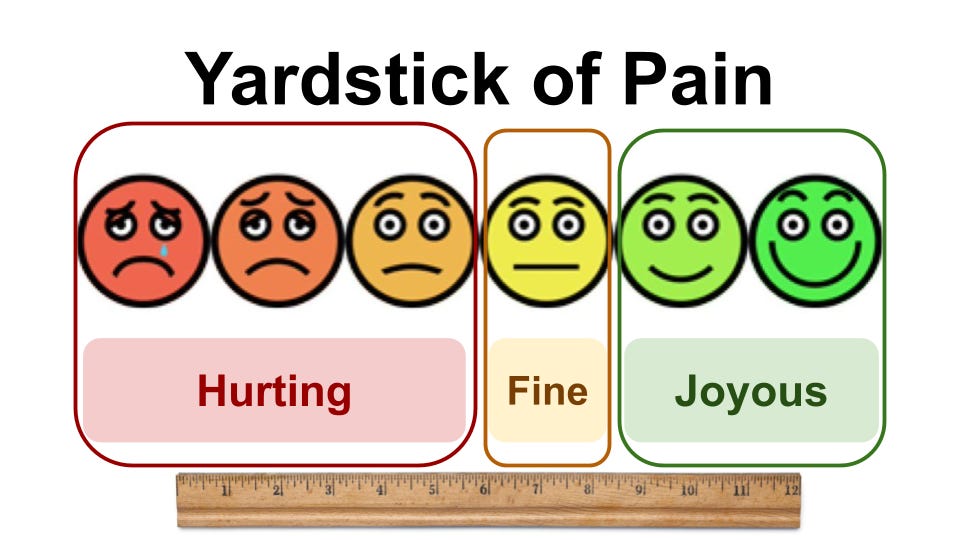
Most interviewees will reply to these emotional questions with something like “Yeah, I did it and it was okay.” -- they’re fine. Occasionally, an interviewee might say “Oh, that happened to me last week and it was fantastic” -- they’re joyous. And if we get lucky, someone says “Ugh. I did that and it was horrible.” That person is hurting. And that’s the first sign that a Person in Pain™ might someday become a customer.
Most founders don’t know what they’re looking for
in discovery interviews so they don’t know if they found it.
How many interviews do you need? Conventional discovery programs typically require 100 interviews over the course of months, such as NSF I-Corps. With Nascent, our goal is to work in batches of five interviews over a few days, like a wildcatter prospecting for oil. Wildcatters don’t go a mile deep before deciding; they drill a few feet at a time, look for signal, then decide whether to keep going.
Nascent is the strategy that I wish I would have had for every time I had an idea for a startup. I’ve run hundreds of discovery interviews but still wasted years pursuing bad ideas. Nascent would have clarified what I was searching for (People in Pain!) and the Yardstick of Pain would have let me categorize my interviewees so that I could make a quick decision.
Want to put this into practice? Look around you right now. Every product you see in this world implies People in Pain. Tylenol implies people with headaches. Chairs imply people who have a sore back from standing up. Pick a product near you and try to articulate aloud: What is this product? And what Pain does it imply? Once you can do that with existing products, you can apply it to the products that don’t yet exist, i.e., the product you want to build with your startup. In the coming posts, I’ll detail how to go from categorizing interviewees using the Yardstick of Pain bins to quantifying them in dollars with an ERNY™ value (Estimated Revenue Next Year).
Mike supports founders of pivoting startups who want to quickly decide a new direction using structure, not intuition. Book a call with me to protect your remaining runway by calculating Estimated Revenue Next Year ($) for your pivot ideas.
For the past 10 years, I’ve been building Nascent as the strategy for startups with no customers. As of 2026, I’m publishing Nascent, a few ideas at a time, in regular podcast episodes. This is the companion newsletter that summarizes the podcast. For a deeper dive, check out the podcast on Spotify / Apple Podcasts / YouTube.