

👋 Hi, I’m Mike. This is the companion newsletter for my podcast (Spotify, Apple, YouTube).
I believe that speaking with people is the best way to vet a startup idea, but only when founders know what they’re looking for. Unfortunately, most founders aren’t sure what to search for, which is why it’s so common for founders to waste a year pursuing a bad startup idea.
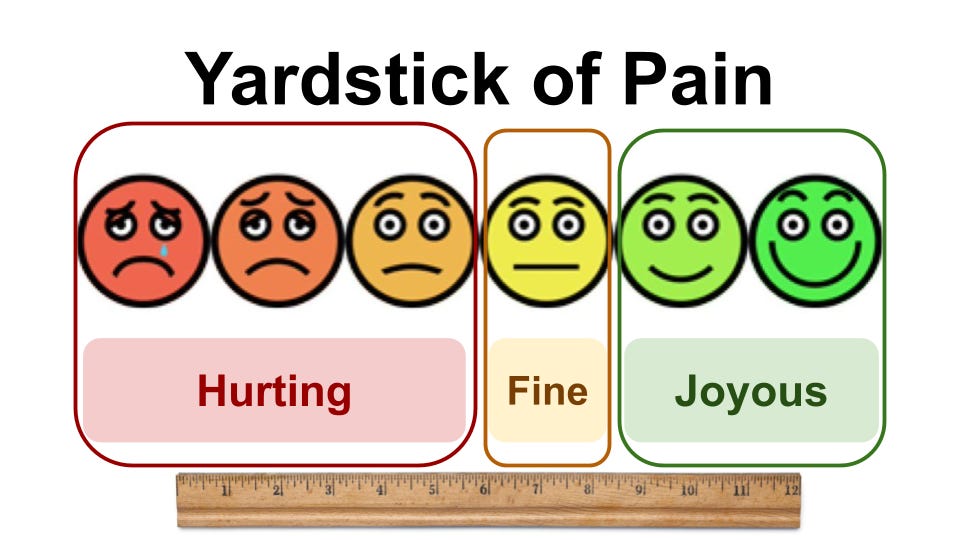
What’s most important? Founders need to understand interviewees’ feelings about the problem the startup will solve. Nascent is a strategy for founders of startups with no customers that includes a tool called the Yardstick of Pain™ to characterize interviewees’ emotions.
Here’s a case study with a real founder named Flora who came to me to vet an idea for her startup. She only wanted to work on it if there was a good chance it would get customers. We applied Nascent to vet her startup idea in days, not years, beginning with characterizing emotions.
As an entrepreneur and a mom, Flora noticed that shopping for kids is overwhelming and wanted to solve this problem with “BundleShop”, an app for moms to shop for bundles of stuff for their kids. The idea for the app doesn’t matter -- only that it implies overwhelmed moms — People in Pain™ who might become customers. So our plan was for Flora to interview moms and categorize each interviewee’s emotions using the Yardstick of Pain as either hurting, fine or joyous.
Side note before I share takeaways from the case study: Normally, this newsletter is a summary of the podcast for folks who don’t have time to listen. In this case, I strongly encourage you to at least listen to the interview clips, starting here.
This case study was the focus of workshops that I ran last year, so I want to share some of the lessons learned. One recurring theme was that a number of participants’ biases led them to misinterpret the interviews. For instance, in one interview a mom talked about all the many places she went to shop for her kid’s birthday party. Her tone was completely indifferent. Nonetheless, a participant was convinced that the mom must be hurting because traveling to all of those places is clearly a pain. Yes, going around town is a pain for the workshop participant, but that’s not the question. The goal of the exercise was to categorize the experience for the interviewed mom, and that interviewee was fine. This type of mischaracterization is a driving factor that leads founders to believe that their startup is going to get customers when the chances are actually doubtful.
After training, participants began to identify interviewees’ emotions. For instance, they latched on to the audio clip of another mom who said, “that [shopping] sometimes makes me anxious.” These types of negative emotions -- anxiety, stress, worry -- are exactly what founders need to search for.
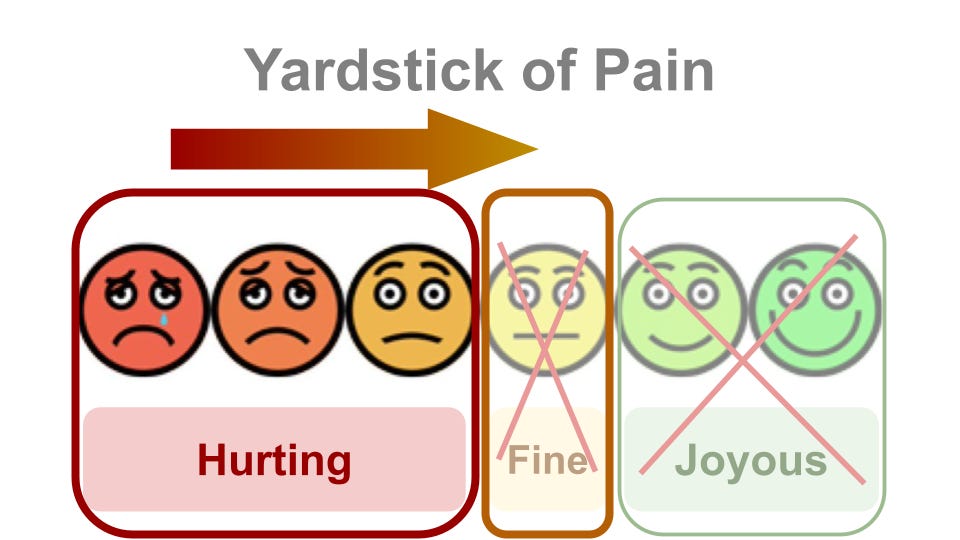
As a founder, your ultimate goal is to create a product that moves customers along the Yardstick of Pain. People who are joyous have nowhere to go. People who are fine theoretically could move up to joyous, but the chances are so low that it’s not worth trying. Only people who are hurting and want to become fine might be your startup’s first customers.
Want to put this into practice? Over the past few posts, I’ve asked you to record conversations with people who might benefit from your startup. The next step: listen to those recordings and categorize the pain of each interviewee using the Yardstick of Pain. This is the first step towards quantifying a startup idea in dollars with an ERNY™ value (Estimated Revenue Next Year).
Mike supports founders of pivoting startups who want to quickly decide a new direction using structure, not intuition. Book a call with me to protect your remaining runway by calculating Estimated Revenue Next Year for your pivot ideas.
For the past 10 years, I’ve been building Nascent as the strategy for startups with no customers. As of 2026, I’m publishing Nascent, a few ideas at a time, in regular podcast episodes. This is the companion newsletter that summarizes the podcast. For a deeper dive, check out the podcast on Spotify, Apple Podcasts and YouTube.
A simple idea, but focusing on real emotions instead of assumptions is what makes customer interviews actually useful