

👋 Hi, I’m Mike and I’m obsessed with startups with no customers. This newsletter 030.3 📬 is a deep dive into how I measured reliability for Nascent, as discussed in Episode 030 of the Nascent podcast 🎧 (Spotify, Apple, YouTube).
No, founders cannot innately generate meaningful analyses of discovery interviews, but it’s a skill they can learn. Running discovery interviews and interpreting the results is a type of data transformation. We can measure the reliability of this data transformation using Krippendorff’s Alpha, which I measured for Nascent. The takeaway: I saw a dramatic increase in founders’ reliability after training. Here’s how the measurement worked.
Back in Episode 028, I described a case study where a founder named Flora used Nascent to evaluate her idea for a startup called BundleShop — an app for moms to shop for bundles of stuff for their kids. Flora recorded interviews with a bunch of moms and we analyzed the interviewees’ emotions.
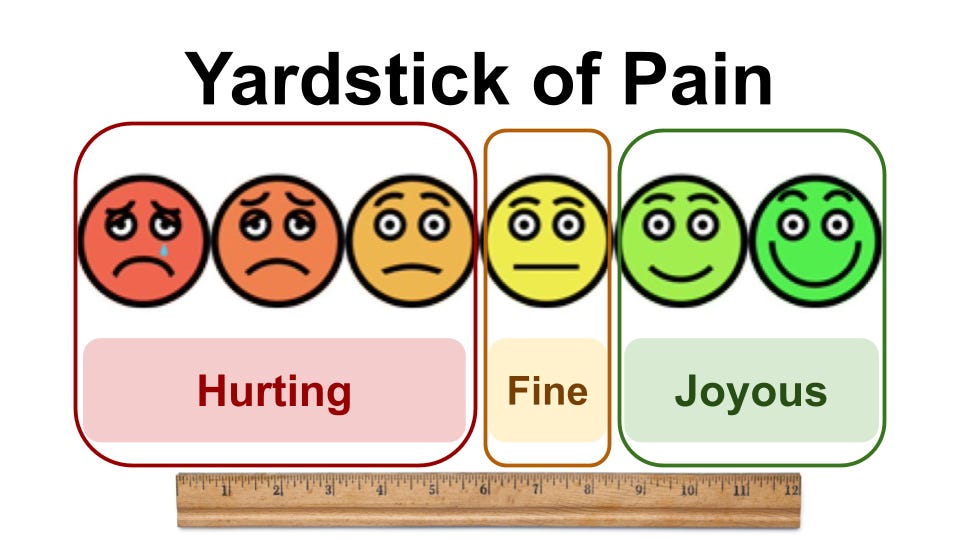
The BundleShop case study was the focus of my content analysis for Nascent. Specifically, I ran workshops where participants analyzed Flora’s conversations using Nascent’s data transformation scheme, the Yardstick of Pain™. Nascent categorizes an interviewee’s emotions as either hurting, fine or joyous. I instructed workshop participants to listen to brief audio clips from Flora’s five interviews and categorize the interviewees’ emotions.
I used the workshops as an opportunity both to train founders and to measure K-Alpha. I was careful to measure K-Alpha both before and after training for 79 participants. I gave the workshop participants general guidance (“search for Pain”) for the first two interviews, which resulted in a K-Alpha = 0.1, meaning that participants’ ratings were essentially random. They might as well have flipped a coin to decide whether an interviewee was hurting, fine or joyous.
To train the participants, I pointed out key details in the first two interviews, such as how an interviewee’s tone and word choice relate to the level of emotional Pain. After the first two interviews, I considered the participants trained and let them categorize the final three interviews without me interrupting. For these post-training clips, Krippendorff’s Alpha jumped to 0.8, indicating much more reliability.
I want to be clear that I consider this measurement just the beginning of what I hope to accomplish with Nascent, since it comes from just 79 raters evaluating 5 interviews for 1 startup. Still, this dramatic increase from randomness to reliability has huge implications for founders of startups with no customers. As much as founders are told to run interviews and make inferences, this is not something that founders can do inherently. But the jump from 0.1 to 0.8 shows that it’s a skill founders can learn.
Founders need to be aware of content analysis but don’t need to be experts, in the same way that a baker uses a thermometer but doesn’t need a PhD in physics. If you’re a founder interpreting a discovery interview, ask yourself what data transformation scheme you’re using and whether you measured it with content analysis or something similar. If not, be skeptical of the takeaways.
Many thanks to Paul Tepper for letting me know about content analysis and providing feedback on how I’m applying it to Nascent.
Mike supports founders of pivoting startups who want to avoid wasting another year on a bad idea. I offer personalized workshops that train your team to reliably analyze discovery interviews. Book a call with me at NascentIdea.com.
For the past 10 years, I’ve been building Nascent as the strategy for startups with no customers. As of 2026, I’m publishing Nascent, a few ideas at a time, in regular newsletter posts and podcast episodes. This is Post 030.3 📬, a deep dive into how I measured K-Alpha for Nascent’s data transformation, as discussed in Ep030 🎧 (17 mins). Read the rest of the deep dives: 030.1: analyzing interviews as data transformation and 030.2: content analysis techniques.
