

👋 Hi, I’m Mike and I’m obsessed with startups with no customers. This newsletter 030.2 📬 is a deep dive into the concept of content analysis, as discussed in Episode 030 of the Nascent podcast 🎧 (Spotify, Apple, YouTube).
Entrepreneurs have a huge opportunity to avoid fooling themselves. Founders already “get out of the building” to run interviews and get feedback on their startup idea. For conventional customer discovery, this means validating assumptions about a business model. For Nascent, this is characterizing the emotions of People in Pain™. Whatever the approach, we can use content analysis techniques to measure how reliably we reach conclusions.
Analyzing discovery interviews is a form of data transformation where founders go from unstructured interview transcripts to specific categories, like “potential customer” and “not a customer”. Analyzing interviews is part of a field of study called content analysis, developed by Klaus Krippendorff, which has been largely focused on the social sciences, at least until now. I believe it unlocks huge opportunities in entrepreneurship, specifically to limit how much founders fool themselves into pursuing bad startup ideas.
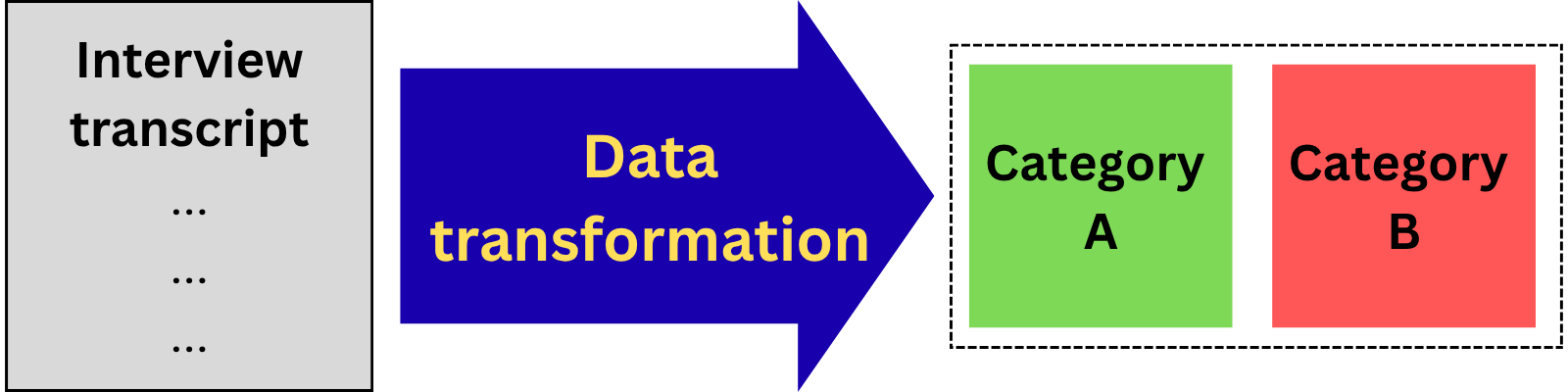
I’m fascinated by the breadth of content analysis, so I want to offer a quick history and then apply it to tech startups.
Back in the 1700s, there was a scandal in Sweden about whether certain religious hymns were “dangerous” or safe. The whole debate was about categorizing religious hymns. A few hundred years later, a similar challenge arose with categorizing newspapers: How do we really know the New York Times is liberal or the Wall Street Journal is conservative? These diverse situations prompt a fundamental question: when people analyze unstructured text — hymns, newspapers, transcripts of discovery interviews — how can we know if our analysis is meaningful and reliable?

Before I share how Krippendorff solved this challenge, first I’ll share the easiest and silliest scheme for transforming raw data into categories. First, you take the unstructured text and just throw it in the trash. Then you simply flip a coin to generate a category. Of course, this is a joke, but what matters is that randomly flipping a coin will generate results. It’s just that the results will be meaningless. This joke reveals a core concept that leads to founders fooling themselves: It’s easy to accidentally invent a fancy coin-flipping machine and not realize it.
A core insight of content analysis is to measure how a data transformation scheme compares to random chance. Specifically, Krippendorff’s idea was to train human raters to apply categorization rules (“a coding manual”) to categorize texts — and then to compare the humans’ results to random chance. Essentially asking: How do the raters compare to coin flips?
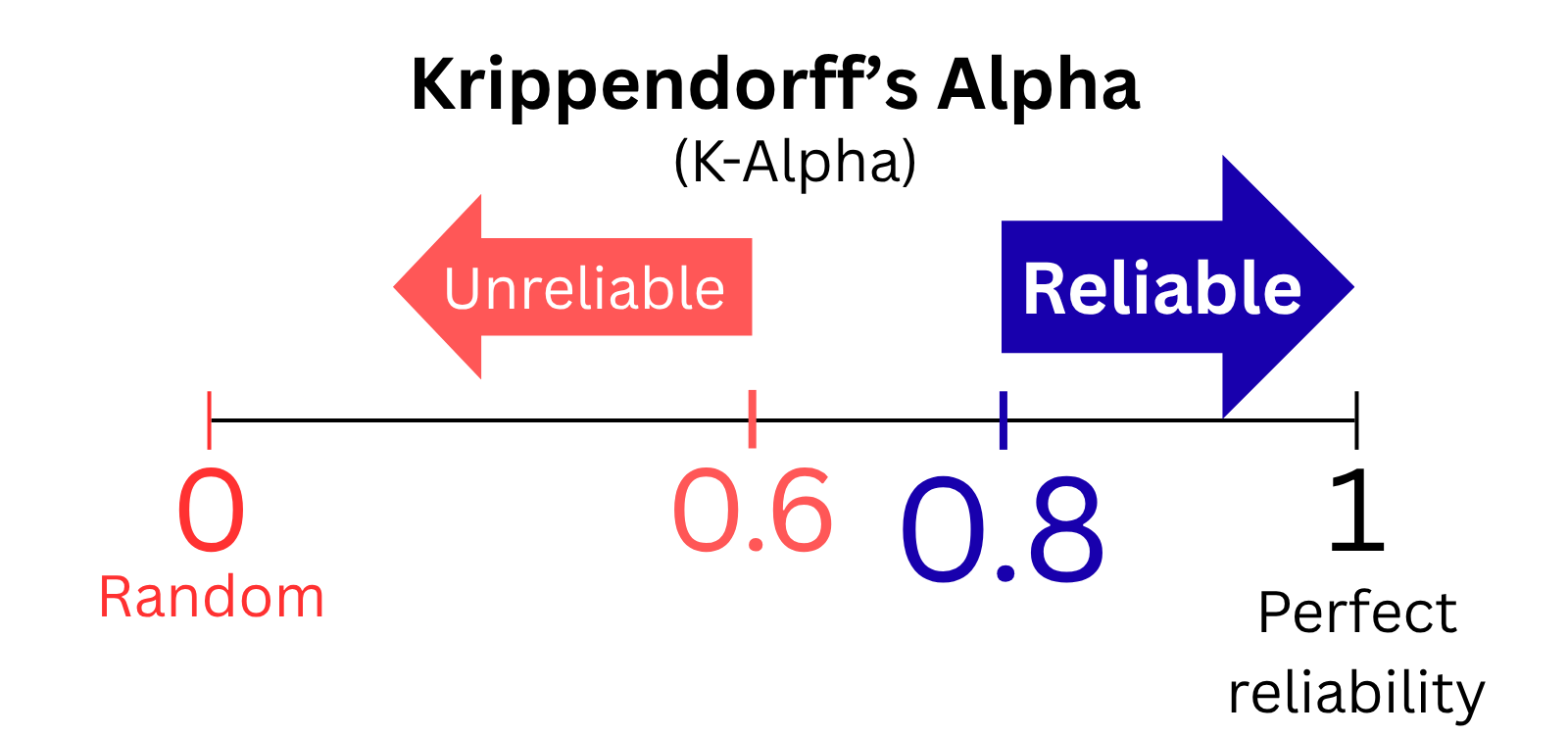
One way to make that comparison is a metric called Krippendorff’s Alpha. K-Alpha goes from 0.0 where the categorization scheme is completely random up to 1.0 indicating perfect reliability — all the raters are in perfect alignment. Roughly speaking, high inter-rater reliability is a K-Alpha of 0.8 or higher, whereas a K-Alpha below 0.6 indicates that the scheme is not reliable, i.e., it might as well be a coin-flipping machine.
Content analysis empowers founders to go from asking the wrong question, “Do we have a process for analyzing interviews?” to instead ask the more meaningful question: “How reliable is our process?”
Every time a founder speaks with someone about a startup idea, they’re making inferences. Content analysis just lets us do it reliably. In future posts, I’ll show you how I used these tools to measure the reliability of Nascent itself.
Many thanks to Paul Tepper for letting me know about content analysis and providing feedback on how I’m applying it to Nascent.
Mike supports founders of pivoting startups who want to avoid wasting another year on a bad idea. I offer personalized workshops that train your team to reliably analyze discovery interviews. Book a call with me at NascentIdea.com.
For the past 10 years, I’ve been building Nascent as the strategy for startups with no customers. As of 2026, I’m publishing Nascent, a few ideas at a time, in regular newsletter posts and podcast episodes. This is Post 030.2 📬, a deep dive into the concept of content analysis discussed in Ep030 🎧 (17 mins). Read the rest of the deep dives: 030.1: analyzing interviews as data transformation and 030.3: how I measured the jump in Krippendorff’s Alpha.
