

👋 Hi, I’m Mike and I’m obsessed with startups with no customers. This newsletter 📬 is a deep dive into the concept of data transformation, as discussed in Episode 030 of the Nascent podcast 🎧 (Spotify, Apple, YouTube).
Analyzing discovery interviews, going from conversations to conclusions, is a form of data transformation. When you consider customer discovery from this perspective, it unlocks an opportunity. Founders can use content analysis techniques to measure the reliability of how they reach conclusions.
An entrepreneur has just one priority when they have a startup idea: search for a signal about their startup’s likelihood to get customers. And the best way to do that is through discovery interviews, by speaking with people who might become the startup’s first customers.
As a mentor, I’ve seen that founders often struggle with discovery interviews. In terms of data gathering, founders have told me that they’re unsure what questions to ask. And then with data analysis, founders also say that they don’t know how to make sense of the answers that they get.
Nascent addresses the data-gathering challenge by offering founders a mental framework: a startup is a project to create new, valuable knowledge about People in Pain™. For data analysis, Nascent provides founders with a tool called the Yardstick of Pain™ to characterize the emotions of an interviewee. All this to say, founders’ challenges around data gathering and data analysis are important, but there’s an even bigger issue with the reliability of our analysis. How do we know that the conclusions we draw are reliable?
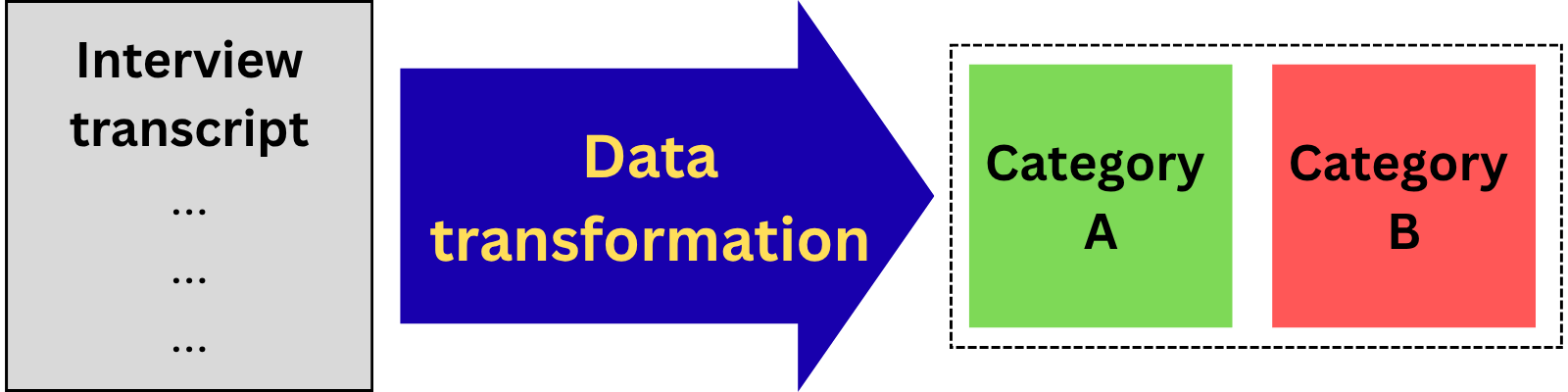
At a high level, analyzing interviews is a data transformation. Founders take a raw, unstructured interview transcript and reduce it down to something like Category A and Category B. Specifically, Nascent has founders use the Yardstick of Pain to categorize interviewees as “hurting, fine or joyous”. Similarly, conventional customer discovery has founders categorize assumptions about a business model as “valid or invalid”. Even in a quick chat, when a founder says to a friend, “I’ve got an idea for a startup -- let me know what you think”, the founder is transforming data from the conversation into takeaways about the startup idea. In all of these cases, founders tell themselves stories about what they learned in the conversations.

The Nobel Prize winner Daniel Kahneman says in his book Thinking, Fast and Slow:
High confidence means that we’ve structured a coherent story, not that the story is true.
For instance, when a gambler in a casino blows on their dice, it means that they’ve told themselves a coherent story that blowing cool air brings good luck. As founders, it’s easy to tell ourselves a coherent story about our takeaways from a discovery interview. Data transformation based on vibes is a recipe for fooling ourselves.
What we really need is to analyze interviews reliably. The good news is that there are tools from other fields that we can apply to our challenge, specifically content analysis and a metric called Krippendorff’s Alpha.
Many thanks to Paul Tepper for letting me know about content analysis and providing feedback on how I’m applying it to Nascent.
Mike supports founders of pivoting startups who want to avoid wasting another year on a bad idea. I offer personalized workshops that train your team to reliably analyze discovery interviews. Book a call with me at NascentIdea.com.
For the past 10 years, I’ve been building Nascent as the strategy for startups with no customers. As of 2026, I’m publishing Nascent, a few ideas at a time, in regular newsletter posts and podcast episodes. This is Post 030.1 📬, a deep dive into the concept of data transformation discussed in Ep030 🎧 (17 mins). The deep dives continue in 030.2: content analysis techniques and 030.3: how I measured the jump in Krippendorff’s Alpha.
