

👋 Hi, I’m Mike and I’m obsessed with product discovery, measured in dollars. This is the summary newsletter 📬 for Episode 032 of the Nascent podcast 🎧 (Spotify, Apple, YouTube).
A huge difference between early-stage startups and public companies is how easily we can value companies like Google, as opposed to how hard it is to identify a good startup idea, especially when the startup has no customers. My goal with Nascent is to bridge this gap and make startup ideas measurable in dollars.
Where do valuations come from for public companies?
And how could we value startup ideas?
Companies listed on a stock exchange publish their performance, which drives their valuations. Last year in 2025, Google said that they made $130B in profit at a 30% growth rate, which caused the stock market to value Google at a $4T market capitalization. By contrast, Spirit Airlines had a negative profit of $2B and the market valued them at just $50M. What I find most compelling about market cap valuations is that they’re based on first-hand data. These valuations tie back to real money that actual customers paid these companies.
As a founder of a startup with no customers, you’re probably hoping for a billion-dollar valuation someday — but how much is your startup idea worth right now?
The only metric I’ve seen come out of discovery interviews is a count, as in a founder saying that they “interviewed 100 people”. Counts are action-based metrics that say nothing about accomplishment. Just because you walked 100 steps doesn’t mean that you’re any closer to your destination; you could’ve just walked in a circle.
What founders desperately need, but have never had, is a way to value a startup idea in dollars. Founders need a way to distinguish 10¢ ideas from $10M ideas. The perspective of Nascent is that (1) every product is a Pain-relief device and therefore (2) the value of the startup idea is determined by the People in Pain that the founder interviews.
The good news is that we can extract a dollar-based signal from those discovery interviews. Specifically, we can leverage behavioral economics and psychology because of how they map to the emotional journey of a Person in Pain™ along the Yardstick of Pain™. Nascent assigns values based on how a Person feels about the problem the startup intends to solve:
$1 of Pain to someone who is hurting, meaning they have some Pain.
$0 of Pain to someone who is fine, meaning they have no Pain.
−$1 of Pain to someone joyous, meaning they have negative Pain — the opposite of a problem to solve.
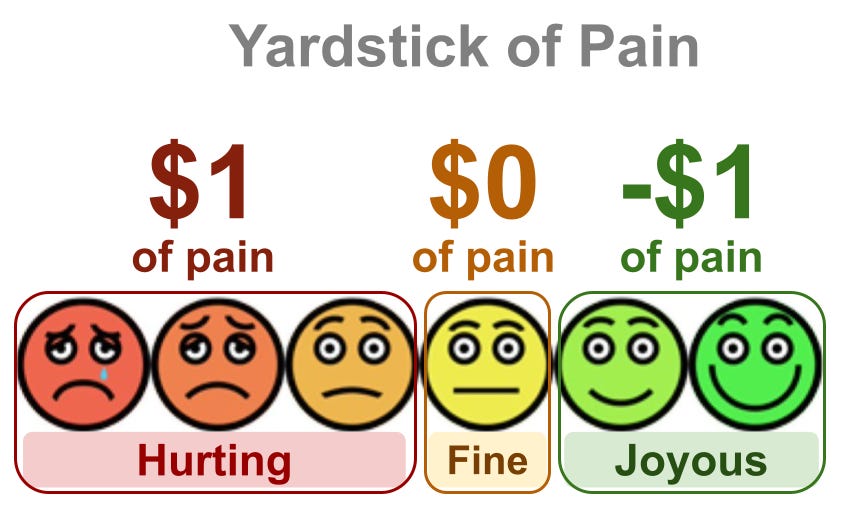
The point of these dollar amounts is to provide an initial signal with directionality, not a precise measurement. What matters is that someone with at least $1 of Pain might pay for Pain relief. Maybe 1¢ or maybe $1,000 — later we’ll refine the estimate, but to start we’ll just use $1 to show they’d consider Pain relief. By contrast, a person with $0 of Pain has no Pain so they won’t pay for Pain relief. Even worse is someone with −$1 of Pain — a founder would have to pay them to use the product.
Over the coming posts, I’ll expand on the big ideas in this episode: why people who feel fine will not become customers, whereas only people who are hurting might pay and the details of converting customer discovery interviews into dollars. This initial signal is a crucial step towards calculating a value for a startup idea: the Estimated Revenue Next Year (ERNY) from the ground up with no customers today, only using discovery interviews.
Mike supports founders of pivoting startups who want to avoid wasting another year on a bad idea. I offer personalized workshops that train your team to reliably analyze discovery interviews. Book a call with me at NascentIdea.com.
For the past 10 years, I’ve been building Nascent as the strategy for quantifying product discovery. As of 2026, I’m publishing Nascent, a few ideas at a time, in regular newsletter posts and podcast episodes. This newsletter summarizes podcast Ep032. For a deeper dive, check out the podcast on Spotify / Apple Podcasts / YouTube.