

👋 Hi, I’m Mike and I’m obsessed with product discovery, measured in dollars. This is the summary newsletter for Episode 035 of the podcast on Spotify, Apple, YouTube.
If you have a startup idea but no customers, then you’re in a Catch-22. Customers are the best sign that a startup is worth your time — but you need to invest a bunch of time to get customers in the first place. This leads to the most common outcome in entrepreneurship: a founder wastes a year before realizing that their startup idea will never get lots of customers. ⏳🤦♀️ This is why I believe a founder’s first step should be to answer the question: Is this startup idea worth pursuing? ⚖️
Since this question is vague, Nascent reduces it to a more specific, answerable question: What are the chances of the startup getting customers? 🔬
Conventional startup strategy tells founders to conduct customer discovery interviews and run two types of analysis: validating hypotheses and counting interviews. For example, this is the premise of the NSF’s I-Corps program, where founders run “100 customer interviews.”
The good thing about a count is that it’s quick to evaluate and enables basic decisions. If a founder has only run 1 or 2 interviews, then that low count shows they have more work to do. But a count can’t support deeper analysis because it measures action, not outcome. The outcome that matters is whether the interviews found People in Pain™ who could become the startup’s first customers. Running 50 or 100 interviews doesn’t indicate that. There’s got to be a better way.
Nascent offers an alternative analysis tool: the Quantified Pain Graph™, which is presented in this episode of the Nascent podcast. Specifically, we created a graph for “BundleShop,” the startup in our case study from Episode 028. That startup’s product was going to solve problems for moms who struggle to shop for their kids. The founder had interviewed seven moms, and I worked with her to analyze the interviews using the Yardstick of Pain™, results shown in this table:

Next, we converted the interviewees’ emotions into dollars of Pain and added that column to the table, per the approach detailed in Episode 032:

Last, we pulled out the interviewee name and dollars of Pain columns and plotted them in a bar chart to create the Quantified Pain Graph. This is as quick to interpret as a count. The graph also lets founders instantly and rigorously analyze interview data. When I ran workshops last year, almost all of the 200 participants could immediately interpret the graph.
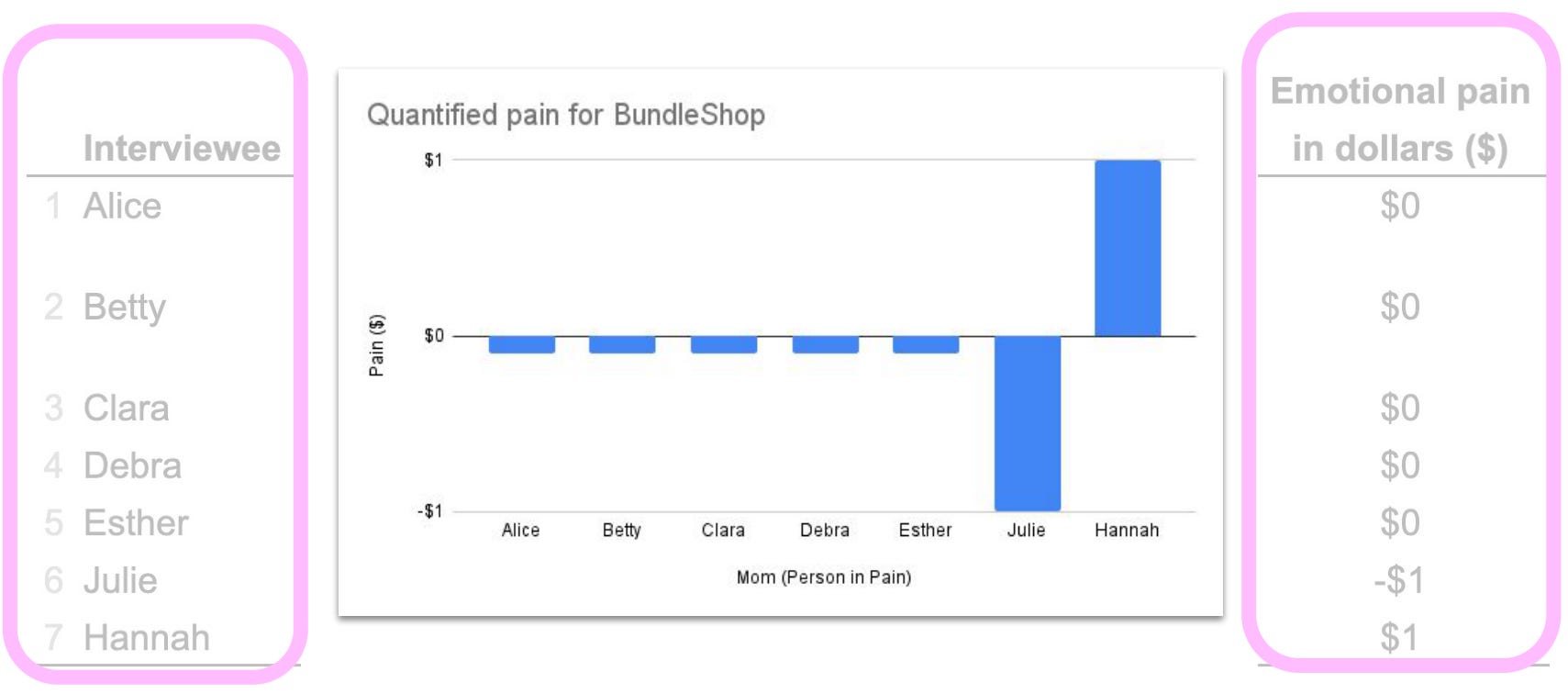
Why does this graph show the chances of getting customers? Anyone who’s ever been a customer of anything ever started as a Person in Pain. Relief is what motivates a Person in Pain to buy a product and become a customer. So every bar at $1 and above is an interviewee who might someday pay for relief. The bars at $0 or below are people who won’t.
The Quantified Pain Graph allows founders to evaluate the chances of their startup getting customers.
The graph also enables a core concept of Nascent: iterative improvement via a cycle called Evaluate → Split → Repeat. Founders visually identify subgroups of People in Pain with valuable problems to solve to refine and improve their startup idea.
As much as conventional startup strategies tell founders “how to get customers”, that promise is meaningless because it’s impossible to keep. What founders can do is stop counting interviews and graph them instead to assess the chances of their startup getting customers.
Mike supports founders of pivoting startups who want to avoid wasting another year on a bad idea. Book a call with me at NascentIdea.com.
For the past 10 years, I’ve been building Nascent as the strategy for quantifying product discovery. As of 2026, I’m publishing Nascent, a few ideas at a time, in regular newsletter posts and podcast episodes. For the full version, check out the podcast on Spotify / Apple Podcasts / YouTube. Here’s everything from Episode 035 🎧:
This episode summary: No, don’t count customer discovery interviews.
Deep dive: Let’s kill the count of customer discovery interviews
Deep dive: Cycles of iterative improvement drive decisiveness
Deep dive: What does “good” look like for a startup with no customers?